Get your flyers on every door.
Circle any neighborhood
Draw the area you want covered on the map — your crew knows exactly which streets to walk.
Assign your crew — or recruit one
Send the job to a crew member you already have, or share a link on Facebook, Instagram, or text to bring someone new on.
Every home checked off
GPS checks off each home as your crew member walks up to it, with no photo or tap at every door. Proof photos come in as often as you set.
GPS-tracked, end to end
Watch where they are and the path they walked, from pickup to the last door. No chasing your team for an update.
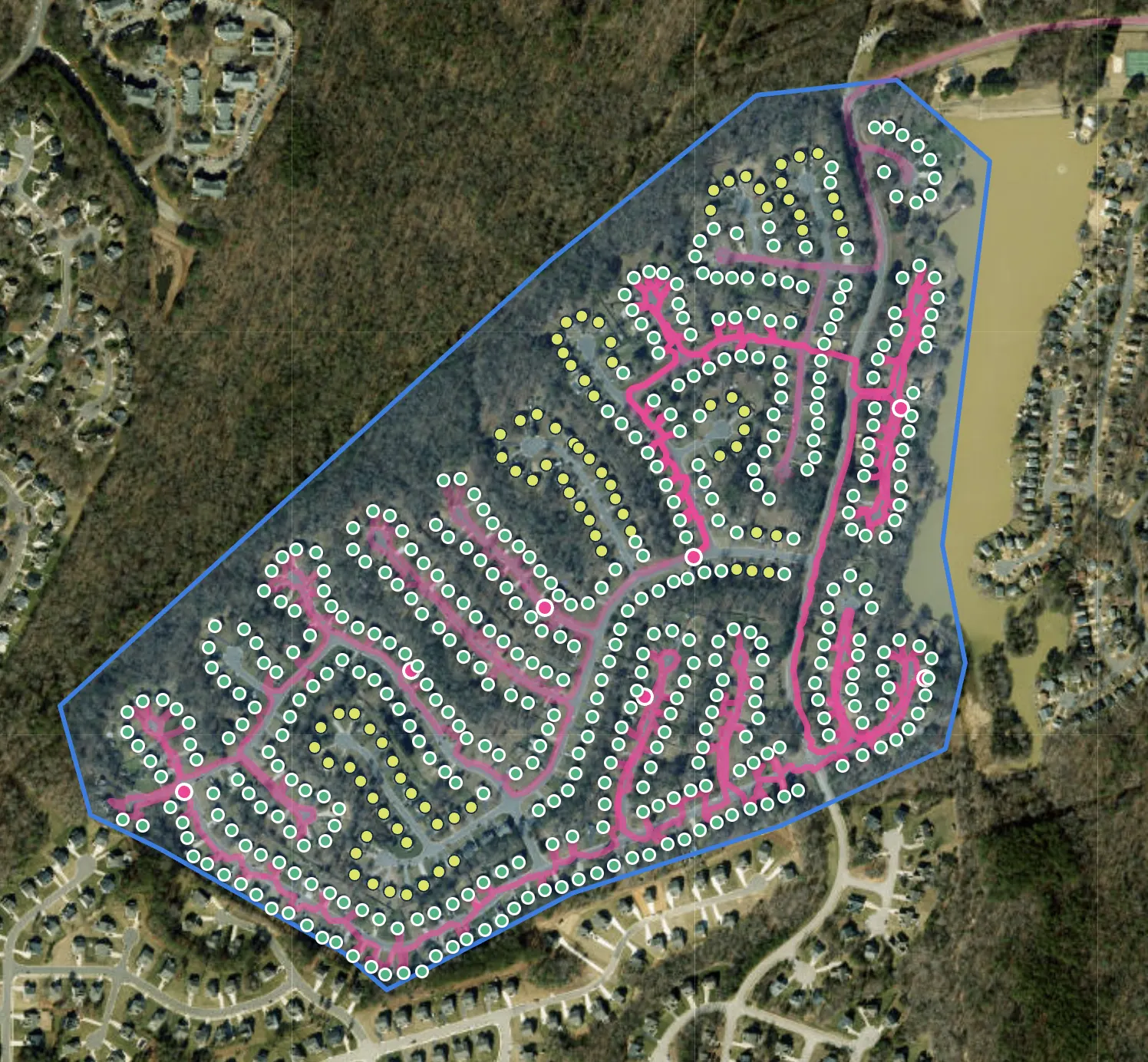
See every home your crew reached
A real FlyerFly route on satellite view. The pink line is the path walked, green dots are the homes reached and yellow dots are the ones still to do, so a skipped street stands out at a glance.
01
Circle the neighborhood
Draw the area on the map and set where your crew picks the boxes up.
02
Assign or share the link
Send it to your own crew member, or drop the recruit link on social media to bring one on.
03
See it happen
Homes get checked off as your crew walks, you watch their path live, and proof photos come in as often as you set.
04
Review and repeat
See which homes got a hanger and which got skipped, what each person earned, and set the route to run again weekly, monthly or quarterly.
- Circle the exact streets you want covered
- Assign jobs to your own crew in seconds
- Share a recruit link on social to bring on new crew members
- Every home checked off by GPS, no photo at every door
- A start photo, plus proof photos as often as you set (or off)
- Track what each person earned
- Recurring routes — hit the same streets weekly
Do I need to have a crew already?
Nope. Assign a crew member you already have, or share your recruit link on Facebook, Instagram, or text and bring one on in minutes.
Do I need to supply my own door hangers?
Yes — you bring your own door hangers and flyers, and your own crew or someone you recruit hands them out. FlyerFly doesn't print them. Door hanger sizes and free printer templates are at flyerfly.io/door-hanger-sizes.
How do I know it actually happened?
Each home is checked off by GPS as your crew walks up to it, your map draws the path they walked, and the route starts with a photo, then proof photos as often as you set.
How do I plan a door hanger route?
Circle the neighborhood on the map. FlyerFly counts the homes inside it, you set where your crew picks up the boxes, and the area becomes the route you assign.
Can I assign routes to my own workers or contractors?
Yes. Invite your team by QR code and send each person their route. FlyerFly doesn't supply workers; use your own, or share a recruit link to bring someone on.
How do I review a finished door hanger route?
Open the route: every home in the area is a dot, checked off where your crew reached it, with the path they walked, the photos and the times. Gaps show up as unchecked homes.
Can I repeat the same door hanger route?
Yes. Set it to repeat weekly, every 2 weeks, every 3 weeks, monthly, every 2 months or quarterly.
Can I do signs too?
Yes — the same job can include yard signs, door hangers, or both. Pick whichever you actually use and the app follows along.
What does it cost?
Why door hangers outwork yard signs for most local trades
A yard sign waits for someone to drive past it. A door hanger is already at the house, on the handle, and has to be picked up before the door opens. One is an impression; the other is an object somebody holds.
That difference decides which one suits which job. Signs are cheap awareness across a whole area and they work hardest where traffic is heavy and slow. Door hangers are expensive attention at a specific address, and they work hardest where you can say something true about that street — the roof two doors down, the drive you cleaned last week, the storm that came through on Tuesday.
Most trades end up running both, but the one that reliably produces calls is the one that reached a particular front door with a particular reason.
Coverage is the number that matters, not the print run
The usual way a door hanger campaign is planned is backwards: order a thousand, then decide where they go. What that produces is a neighbourhood covered until the box runs out, and nobody can say which streets got nothing.
The other order works better. Draw the area first, get the count of homes inside it, then print for that number. Now the campaign has a finish line, and a street that was missed is visible rather than theoretical.
- Circle the blocks, not a radius. A radius crosses rivers, motorways and the boundary between the houses you want and the flats you do not. A drawn shape does not.
- Count before you print. FlyerFly puts one dot per home inside the shape, so the piece count is a number rather than a guess.
- Leave the apartments out. Multi-family blocks eat a print run and rarely produce the homeowner work most trades want. They can be excluded from the count.
The part nobody can verify by hand
Hand someone a box and an address and the honest position afterwards is that you do not know what happened. The phone rings or it does not, weeks later, and a street that was skipped looks exactly like a street where the offer did not land.
That is the specific problem door hangers have and yard signs do not: a sign is visible proof of itself, standing on a corner where anyone can see it. A hanger is gone — taken inside, binned, or never delivered — and all three look the same from your desk.
FlyerFly closes that by recording the round as it happens: the route is drawn in advance, each home is credited when the person covering it actually reaches that door, and the GPS path shows the streets they walked. Photo check-ins sit alongside it. What you get at the end is a map of what was covered, not an assurance.
Who should be doing the walking
The answer for most local businesses is somebody already on the payroll, on a day the weather or the schedule has freed up. Door hangers go out in drizzle; roofs and driveways do not. An hour between jobs covers a street that is already on the way.
What makes that work is handing over a route rather than an instruction. A drawn area and an ordered list of streets can be given to somebody who has never worked that neighbourhood. An address and a box cannot, which is why the job usually falls back to the owner.
What to put on the hanger
The hangers that get kept say something specific about that street rather than something general about the company. A roofer working one storm-hit subdivision has a better line than a roofer advertising roofing.
The practical shape: one offer, one reason it applies here, one way to respond, and the name of the street or neighbourhood if you can manage it. Everything else is decoration. FlyerFly does not print anything — the business supplies its own materials — but what is on them decides what the route is worth.
Common questions
Do door hangers work better than yard signs?
Door hangers and yard signs do different jobs: a yard sign creates cheap awareness across an area and works best on busy roads where traffic slows, while a door hanger puts a physical object in one household's hands and works best when it can say something specific about that street. Most local trades run both, but the campaigns that produce calls are usually the ones that reached a particular door with a particular reason.
How many door hangers do I need for a neighborhood?
Count the homes before ordering rather than ordering first and covering until the box is empty. Drawing the area on a map and counting the single-family homes inside it gives a real piece count, which also means a missed street is visible afterwards instead of hidden by having run out.
How do you track door hanger distribution?
Door hanger distribution is tracked by recording the route as it is walked rather than reconstructing it afterwards: the area is drawn in advance, each home is credited when the person covering it reaches that door, and the GPS path shows which streets were walked. This matters more than it does for yard signs, because a delivered hanger and an undelivered one look identical from a desk.
Is it illegal to put door hangers on doors?
Hanging a door hanger on a door handle is generally permitted, and it is distinct from putting anything inside a mailbox, which is restricted under federal law because approved letter boxes are reserved for posted mail. Local solicitation ordinances and posted "No Soliciting" signs still apply, so check the rules for the city you are covering.
Who should put out door hangers for a small business?
Most local businesses get the best return from their own crew on a day that has freed up, since the labour is already paid for and door hangers go out in weather that stops outdoor work. The thing that makes it workable is handing over a drawn route in a sensible order rather than a box and a neighbourhood name, because explaining the round is what normally stops it happening.
Does FlyerFly print door hangers?
No. Businesses supply their own printed door hangers and yard signs. FlyerFly plans the area, counts the homes inside it, routes whoever is covering it, and records what was actually covered.
FlyerFly is the free app local businesses use to track door hangers and yard signs. No credit card, no subscription.